Millions of Americans are reaching retirement age, fewer children are being born, and immigration is uncertain. AI may be arriving at a time when we increasingly need its help.
The debate about AI taking our jobs often leaves out the people leaving those jobs anyway. Millions of baby boomers are retiring, and the economy will still need much of the work they perform. Before we assume that AI will leave America with too many workers, we should consider whether it could help us manage a future in which employers struggle to find enough.
Millions Are Reaching Retirement Age
Baby boomers, born between 1946 and 1964, are nearing the end of their working years. One demographic study estimated that an average of 4.1 million Americans would turn 65 annually from 2024 through 2030. By the end of 2029, even the youngest boomers will have reached 65, although many will continue working beyond that age. Peak boomer study
The broader aging trend is substantial. America’s population age 65 and older grew from about 40 million in 2010 to nearly 56 million in 2020, and Census projections put it above 71 million in 2030.
2010 — 40.3 million Americans age 65 and older
2020 — 55.8 million Americans age 65 and older
2030 — 71.2 million Americans age 65 and older, projected
These figures describe all Americans age 65 and older, including people who still work. They are population counts and a projection, not retirement totals. Sources: Census historical counts and federal aging indicators using Census projections.
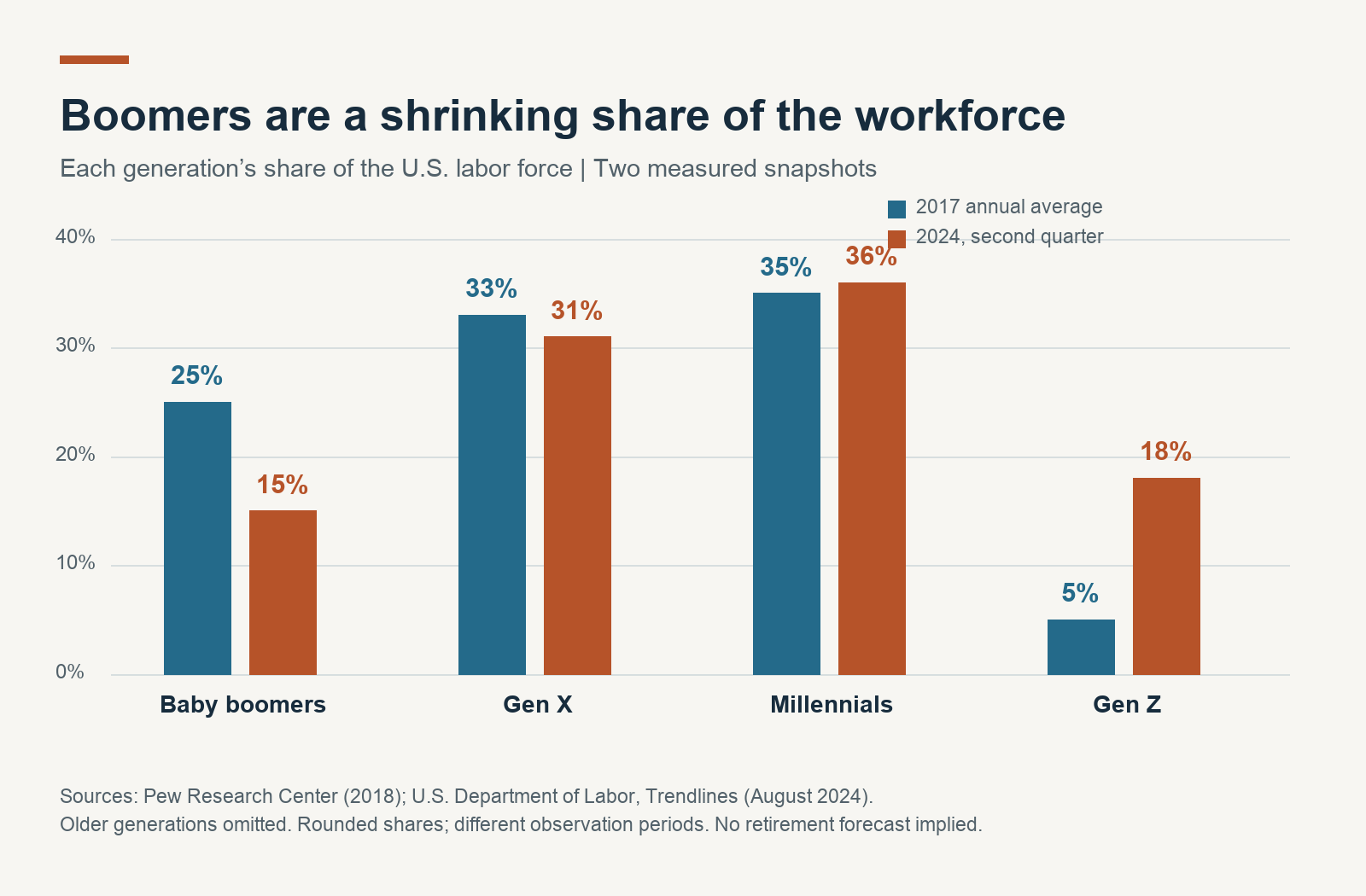
The change is already visible in the workforce. Boomers represented about 25% of the labor force in 2017, compared with 15% in the second quarter of 2024. Younger generations have taken a larger share as older workers leave, but that transition still requires employers to replace experience, skills, and the capacity to get work done. Pew Research Center, U.S. Department of Labor
Fewer Jobs Can Still Mean Plenty of Hiring
A company can need fewer employees overall and still need to hire replacements. Imagine an accounting department with ten employees. Three retire, and new software allows the department to operate with nine people. The company still needs to hire two people, even though it has eliminated one position.
National projections show a similar pattern. The Bureau of Labor Statistics expects employment among bookkeeping, accounting, and auditing clerks to fall by about 86,000 positions between 2025 and 2035. Yet it also expects approximately 144,000 openings every year in that field because workers retire, leave the workforce for other reasons, or move into different occupations. These are clerical roles, rather than accountants as a whole. BLS occupational outlook
Automation helps explain the projected decline: software allows fewer employees to handle the same work. But employers still need replacements for many departing workers. That is the part a simple “jobs lost” headline misses—and a reason some AI adoption could happen through retirement and reduced replacement hiring.
Fewer Births Add Another Pressure
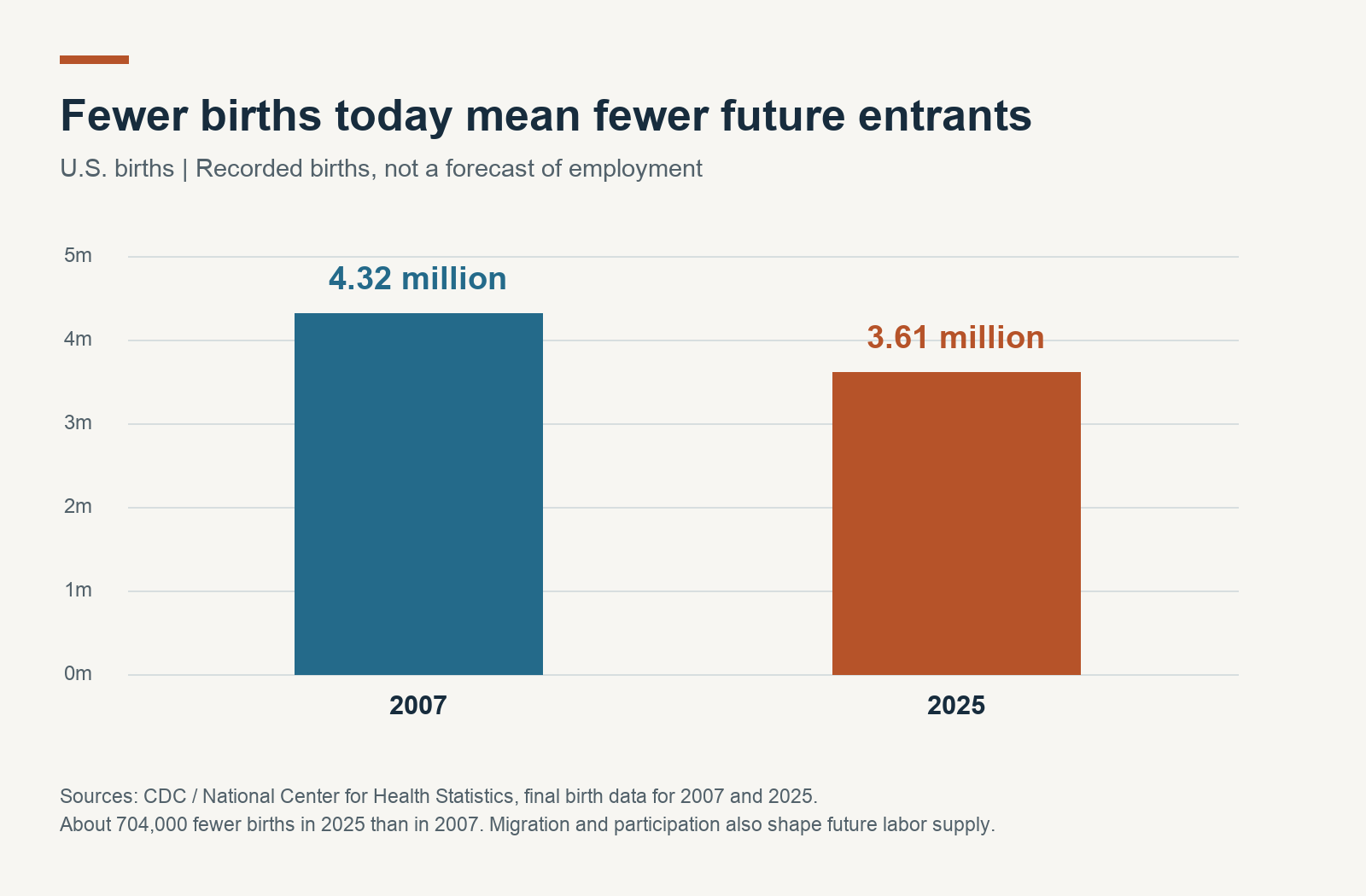
Retirement is only part of the story. The generations that will eventually enter the workforce are also being shaped by years of lower births. America recorded about 4.32 million births in 2007, compared with 3.61 million in 2025—roughly 704,000 fewer children in that single year’s birth group. CDC 2007 data, CDC 2025 data
Those smaller groups do not affect hiring immediately. Children born in 2025 will begin reaching adulthood in the 2040s, when employers will be recruiting from a smaller U.S.-born generation than the one reaching adulthood today. Immigration and the number of people choosing to work can change the outcome, but lower births create a lasting constraint.
Even a sudden increase in births would take roughly two decades to produce additional adult workers. Meanwhile, the Congressional Budget Office projects that deaths will exceed births beginning in 2030, making immigration responsible for all net population growth. We cannot count on a growing population to keep supplying workers at the pace businesses once expected. CBO demographic outlook
Immigration Could Help—or Make Hiring Harder
Immigration can respond much sooner than birth rates because adults can arrive ready to work. It already contributes substantially: foreign-born people represented 19.1% of the U.S. labor force in 2025. A reliable immigration system could help employers fill positions as older workers retire. BLS foreign-born workforce report
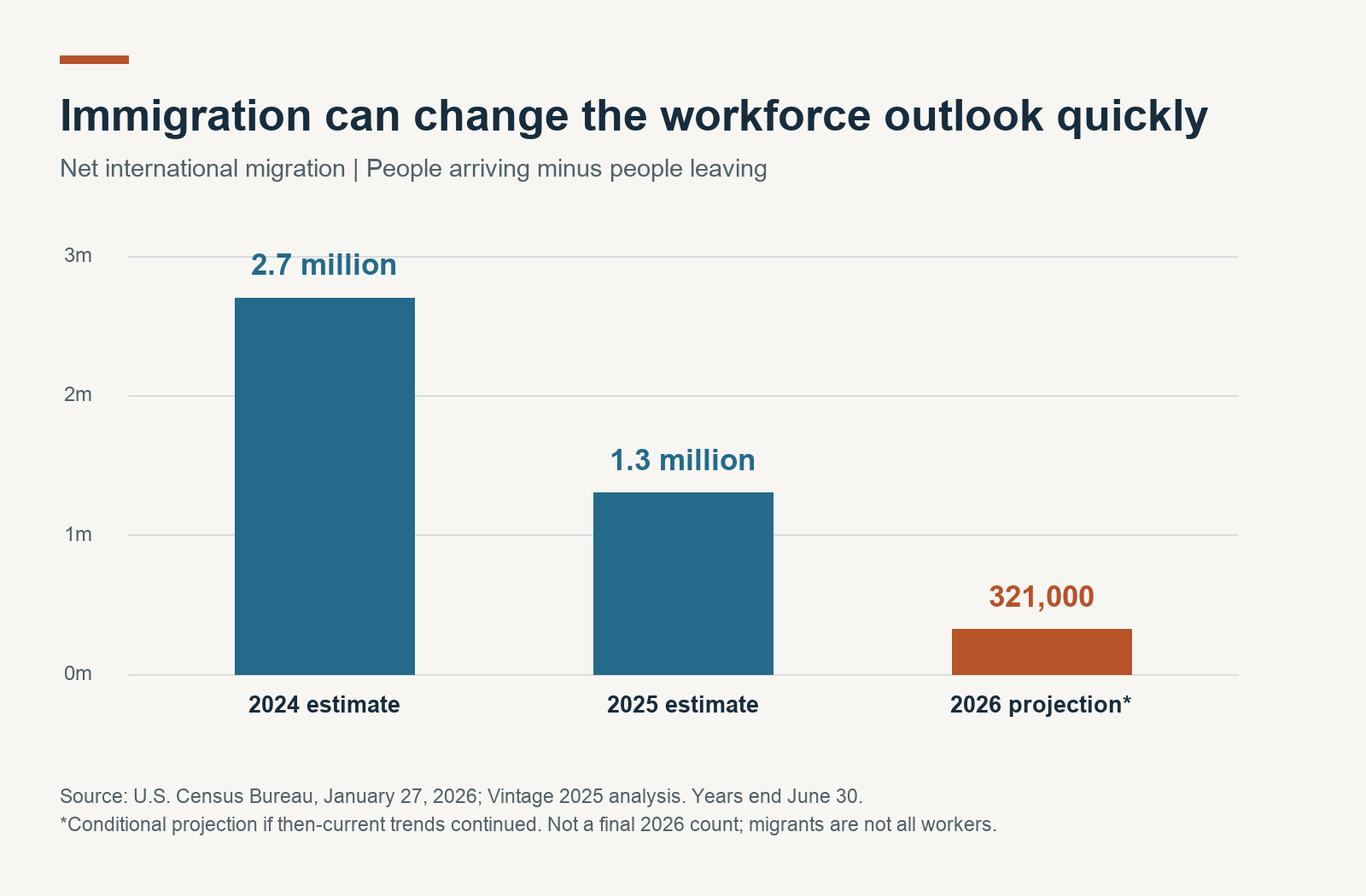
But immigration is also the least predictable part of this picture. Census estimates show net international migration falling from 2.7 million in 2024 to 1.3 million in 2025. Its January 2026 analysis projected a further decline if then-current trends continued, illustrating how quickly that source of population growth can change. Census migration analysis
Policies that restrict arrivals or make it harder for immigrants to remain and work can intensify future hiring pressures. Policies that provide workable legal pathways can ease them. That makes immigration a major variable in how much employers will need to rely on technology to maintain and expand their operations.
AI Could Help Cover the Work Departing Employees Leave Behind
Taken together, retirement, lower births, and uncertain immigration give us a different way to assess AI. Employers will face pressure to produce more without being able to count on a rapidly growing supply of workers. Technology that helps existing employees accomplish more could become essential to keeping services available and businesses growing.
That does not mean every job AI eliminates will conveniently match a retirement. People can lose jobs while employers elsewhere struggle to hire, and younger workers could find fewer opportunities to gain experience. The U.S. workforce is also still projected to grow, so the argument is about slower growth and difficult replacement needs—not a guaranteed nationwide worker shortage. CBO economic outlook
Still, predictions of mass unemployment need to account for the people leaving work as well as the tasks machines can perform. AI may help an employer manage a retirement, serve more customers, or expand an operation that would otherwise be limited by staffing. Its value will often depend on how well it supports the people who remain.
Communities Should Prepare for the Work People Will Still Need
Communities can respond by aligning workforce programs with local hiring needs and the tasks that remain difficult to automate. For instance, an AI system that processes invoices cannot, by itself, provide bedside care, repair a water line, or install an electrical panel. Those jobs involve physical work, changing conditions, and responsibility for people’s safety.
Community colleges, school systems, and employers should strengthen training in fields such as health care, skilled trades, infrastructure maintenance, and equipment repair where local demand supports it. They should also teach people in those fields to use AI: a nurse may benefit from less paperwork, while a contractor may prepare estimates faster. Preparing workers means developing both their practical skills and their ability to use new tools.
Employers have a role before retirement happens, too. They can give younger employees time to learn from experienced colleagues, document essential procedures, and use technology to reduce routine work. That would make retirement transitions easier while preserving opportunities for the next generation.
The risk of disruption deserves attention, but so does the cost of failing to adapt. We will still need care, housing, infrastructure, and functioning businesses as millions of experienced Americans leave work. AI could help us meet those needs—and its arrival may be better timed than the job-loss debate suggests.